Role
Primary Full Stack Developer
Product and workflow design
UI/UX design and implementation
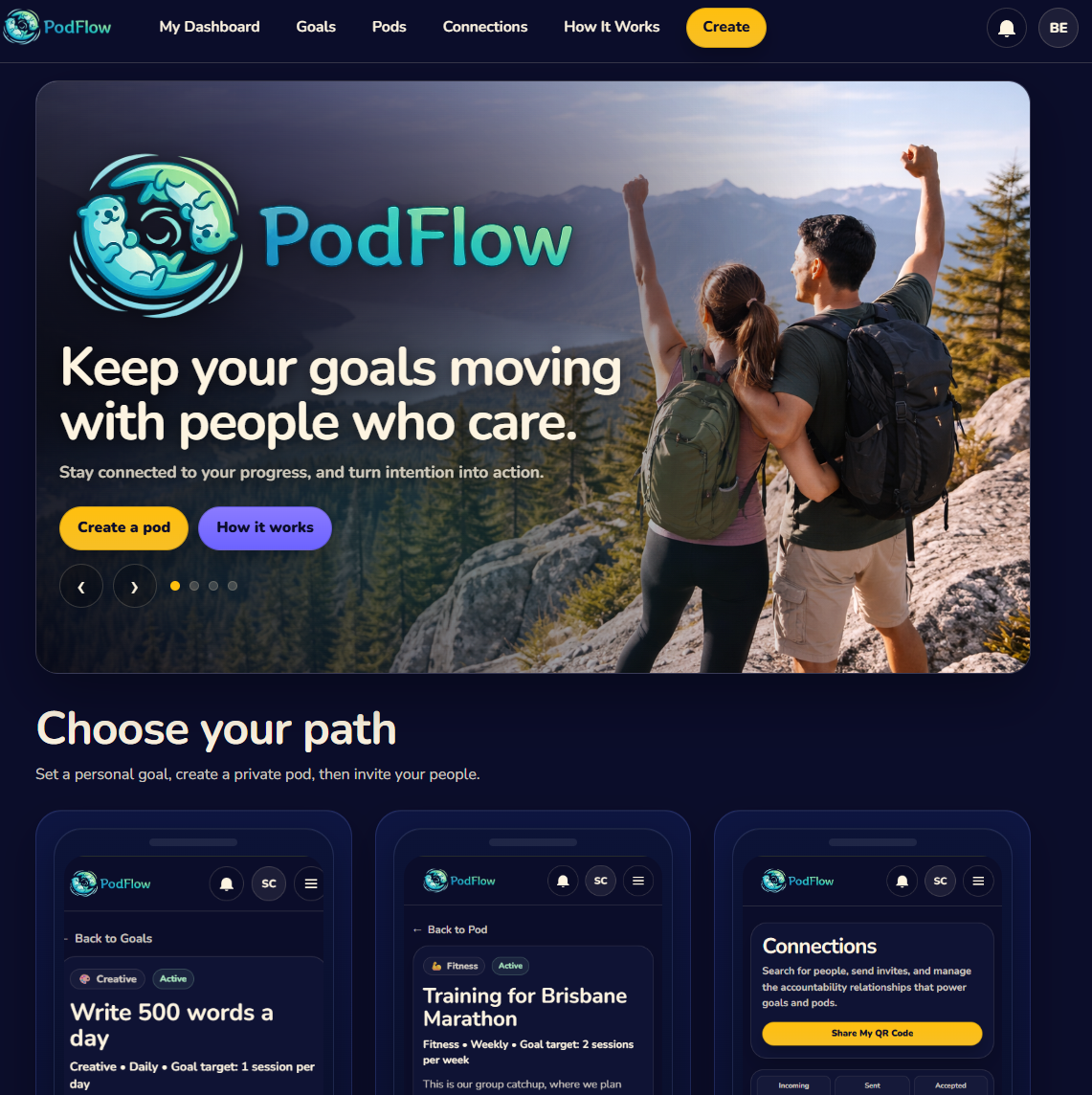
Full Stack Accountability Platform
PodFlow is a private accountability platform designed to help people make real progress with trusted support. Instead of public posting or performative productivity, it focuses on small groups, shared goals, check-ins, and meaningful follow-through.
Built with React, HTML, CSS, Django REST Framework, and PostgreSQL, PodFlow was designed with a strong emphasis on permissions, workflow design, verification logic, notifications, and UI clarity.
Created as a team project, I led the product build and delivered the core application, including frontend development, backend logic, workflow architecture, permissions, notifications, and UI/UX. Teammates contributed testing, project coordination, documentation, social media support, and selected supporting pages.
Many accountability tools rely on public posting, loose goal tracking, or one-size-fits-all workflows. PodFlow was designed as a more private and structured alternative, focused on trusted groups, shared progress, and meaningful follow-through.
That meant designing more than a simple tracking app. The product needed to support individual goals, pod goals, verification workflows, layered permissions, membership states, notifications, and relationship management, while still remaining clear and intuitive to use.
I approached PodFlow as both a product and engineering challenge. The interface needed to feel clear and approachable, while the underlying system supported complex workflows around permissions, verification, notifications, and shared accountability.
I placed a strong emphasis on consistency across the product, so the language, status labels, actions, and workflow logic stayed aligned across different features and user journeys.
These demos show how the product balances a simple user experience with complex workflow logic under the hood.
Workflow visibility
PodFlow uses notifications to guide users through invites, approvals, verification requests, and other important actions across the platform. Because notifications touch so many different workflows, they became a major part of making the product feel intuitive, responsive, and easy to use.
Cross-app consistency
PodFlow supports multiple check-in types, including done/not done, number-based, and duration-based tracking. I designed the interface and language to update accordingly across forms, labels, progress displays, and check-in history.
Trust-first design
PodFlow is designed to make accountability feel more supportive and intentional. By letting users create invite-only pods with trusted people, it encourages clearer participation, stronger follow-through, and a greater sense of shared momentum.
Accountability loop
Check-ins are not just logged and forgotten. PodFlow supports review and approval by others, creating a more realistic accountability model where progress can be verified rather than simply claimed.
Relationship management
PodFlow separates connections from pod membership. Users can build a trusted network first, then handpick the right people into shared spaces and group goals, making collaboration feel intentional from the start.
Backend depth
A major part of the engineering challenge was ensuring that only the right people could view, edit, verify, invite, approve, or manage each part of the system. That meant handling role-based access, membership states, ownership rules, and cross-feature permissions so the product stayed consistent, secure, and predictable.
I designed the app so the language stayed consistent across forms, labels, progress displays, and check-in history. That consistency helped complex workflows feel clear and intuitive across the product.
PodFlow supports both individual goals and pod-based goals, with different collaboration, review, and accountability behaviours depending on the context.
Access is not just determined by whether someone belongs to a pod. It also depends on their role, membership status, ownership, and the specific action they are trying to perform.
Notification logic was designed to support the product’s core workflows, helping users respond to invites, approvals, verification requests, and other actions needing attention in a clear and timely way.
PodFlow demonstrates the kind of work I enjoy most: translating human behaviour into structured systems. It is not just visually polished. It also models trust, accountability, and shared action in a way that required careful product thinking and technical design.
I’m especially proud of the balance between simplicity and depth. The interface stays approachable, but the logic underneath is doing serious work: adaptive UI language, layered permissions, realistic verification, thoughtful relationship management, and clean workflow handling across the site.
Next Case Study
Backyard Festival shows a different side of my work, with community crowdfunding, supporter flows, and a strong visual identity.